
Tony Black Tony Black
0 Course Enrolled • 0 Course CompletedBiography
Pass Exam With Good Results By Using the Latest Workday Workday-Pro-Integrations Questions
P.S. Free & New Workday-Pro-Integrations dumps are available on Google Drive shared by Easy4Engine: https://drive.google.com/open?id=1mdin2xZHo9R8YFL1Hp60A-7KaOngpX1L
You have to know that a choice may affect your very long life. Our Workday-Pro-Integrations guide quiz is willing to provide you with a basis for making judgments. You can download the trial version of our Workday-Pro-Integrations practice prep first. After using it, you may have a better understanding of some of the advantages of Workday-Pro-Integrations Exam Materials. We have three versions of our Workday-Pro-Integrations learning quiz: the PDF, Software and APP online for you to choose.
Workday Workday-Pro-Integrations Exam Syllabus Topics:
| Topic | Details |
|---|---|
| Topic 1 |
|
| Topic 2 |
|
| Topic 3 |
|
| Topic 4 |
|
>> Workday-Pro-Integrations Latest Exam Book <<
Valid Test Workday-Pro-Integrations Tips & Exam Workday-Pro-Integrations Outline
If moving up in the fast-paced technological world is your objective, Workday is here to help. The excellent Workday Pro Integrations Certification Exam (Workday-Pro-Integrations) practice exam from Workday can help you realize your goal of passing the Workday Treasury with Workday Pro Integrations Certification Exam (Workday-Pro-Integrations) certification exam on your very first attempt. Most people find it difficult to find excellent Workday Treasury with Workday Pro Integrations Certification Exam (Workday-Pro-Integrations) exam dumps that can help them prepare for the actual Workday Pro Integrations Certification Exam (Workday-Pro-Integrations) exam.
Workday Pro Integrations Certification Exam Sample Questions (Q34-Q39):
NEW QUESTION # 34
The following XML code was generated through a RaaS that will be used in an EIB.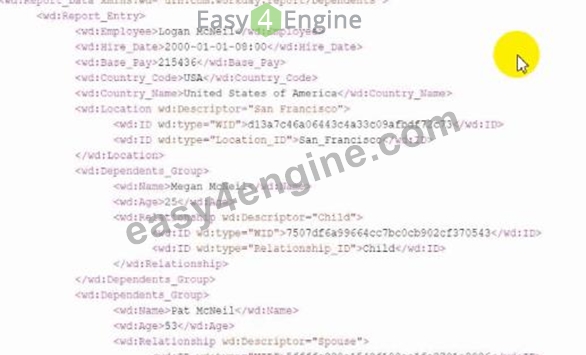
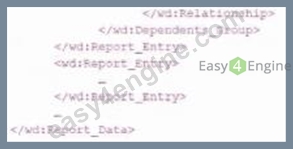
Within a template that matches on wd:Report_Entry, what XPath expression do you use to select the value of the Relationship_ID element?
- A. wd:Dependents_Group/wd:Relationship/wd:ID/wd:type='Relationship_ID'
- B. ./wd:Dependents_Group/wd:Relationship/wd:ID
- C. wd:Dependents_Group/wd:Relationship/wd:ID
- D. wd:Dependents_Group/wd:Relationship/wd:ID/wd:type='Relationship_ID'
Answer: B
Explanation:
The XML fragment shown follows the Report-as-a-Service (RaaS) structure typical for Workday custom report output:
<wd:Report_Entry>
<wd:Dependents_Group>
<wd:Name>Megan McNeil</wd:Name>
<wd:Age>25</wd:Age>
<wd:Relationship wd:Descriptor="Child">
<wd:ID wd:type="WID">7507df6a99664ce7bc0cb902cf370543</wd:ID>
<wd:ID wd:type="Relationship_ID">Child</wd:ID>
</wd:Relationship>
</wd:Dependents_Group>
</wd:Report_Entry>
Inside each <wd:Report_Entry>, the target value Relationship_ID resides under:
wd:Dependents_Group
→ wd:Relationship
→ wd:ID (wd:type="Relationship_ID")
When writing the template:
<xsl:template match="wd:Report_Entry">
XSLT uses a relative XPath (starting with ./) to navigate from the matched node.
Therefore, the correct XPath should be:
/wd:Dependents_Group/wd:Relationship/wd:ID
That expression selects the wd:ID element so you can then test/extract where wd:type="Relationship_ID".
Why the other options are incorrect:
Option
Why Incorrect
A & B
These use an equality test incorrectly inside the XPath expression - they would not return the node value and are syntactically invalid for value extraction.
C
Missing ./ - would still work in many cases, but Workday XSLT best practice is to use relative paths when inside a match.
Workday Pro Integration guidance for RaaS/XSLT stresses:
Always scope node selection relative to the current context tree using prefix-qualified XPath expressions.
NEW QUESTION # 35
Refer to the following XML to answer the question below.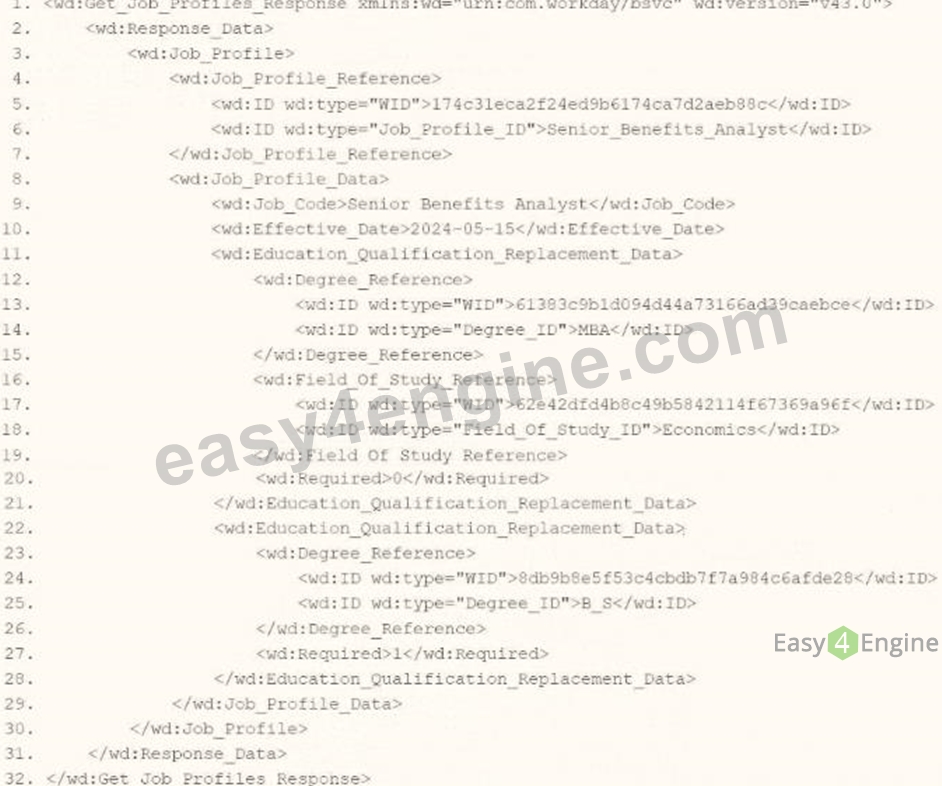
You are an integration developer and need to write XSLT to transform the output of an EIB which is making a request to the Get Job Profiles web service operation. The root template of your XSLT matches on the <wd:Get_Job_Profiles_Response> element. This root template then applies templates against <wd:Job_Profile>. What XPath syntax would be used to select the value of the ID element which has a wd:type attribute named Job_Profile_ID when the <xsl:value-of> element is placed within the template which matches on <wd:Job_Profile>?
- A. wd:Job_Profile_Reference/wd:ID/wd:type='Job_Profile_ID'
- B. wd:Job_Profile_Reference/wd:ID[@wd:type='Job_Profile_ID']
- C. wd:Job_Profile_Reference/wd:ID/[@wd:type='Job_Profile_ID']
- D. wd:Job_Profile_Reference/wd:ID/@wd:type='Job_Profile_ID'
Answer: B
Explanation:
As an integration developer working with Workday, you are tasked with transforming the output of an Enterprise Interface Builder (EIB) that calls the Get_Job_Profiles web service operation. The provided XML shows the response from this operation, and you need to write XSLT to select the value of the <wd:ID> element where the wd:type attribute equals "Job_Profile_ID." The root template of your XSLT matches on <wd:Get_Job_Profiles_Response> and applies templates to <wd:Job_Profile>. Within this template, you use the <xsl:value-of> element to extract the value. Let's analyze the XML structure, the requirement, and each option to determine the correct XPath syntax.
Understanding the XML and Requirement
The XML snippet provided is a SOAP response from the Get_Job_Profiles web service operation in Workday, using the namespace xmlns:wd="urn:com.workday/bsvc" and version wd:version="v43.0". Key elements relevant to the question include:
The root element is <wd:Get_Job_Profiles_Response>.
It contains <wd:Response_Data>, which includes <wd:Job_Profile> elements.
Within <wd:Job_Profile>, there is <wd:Job_Profile_Reference>, which contains multiple <wd:ID> elements, each with a wd:type attribute:
<wd:ID wd:type="WID">1740d3eca2f2ed9b6174ca7d2ae88c8c</wd:ID>
<wd:ID wd:type="Job_Profile_ID">Senior_Benefits_Analyst</wd:ID>
The task is to select the value of the <wd:ID> element where wd:type="Job_Profile_ID" (e.g., "Senior_Benefits_Analyst") using XPath within an XSLT template that matches <wd:Job_Profile>. The <xsl:value-of> element outputs the value of the selected node, so you need the correct XPath path from the <wd:Job_Profile> context to the specific <wd:ID> element with the wd:type attribute value "Job_Profile_ID." Analysis of Options Let's evaluate each option based on the XML structure and XPath syntax rules:
Option A: wd:Job_Profile_Reference/wd:ID/wd:type='Job_Profile_ID'
This XPath attempts to navigate from wd:Job_Profile_Reference to wd:ID, then to wd:type='Job_Profile_ID'. However, there are several issues:
wd:type='Job_Profile_ID' is not valid XPath syntax. In XPath, to filter based on an attribute value, you use the attribute selector [@attribute='value'], not a direct comparison like wd:type='Job_Profile_ID'.
wd:type is an attribute of <wd:ID>, not a child element or node. This syntax would not select the <wd:ID> element itself but would be interpreted as trying to match a nonexistent child node or property, resulting in an error or no match.
This option is incorrect because it misuses XPath syntax for attribute filtering.
Option B: wd:Job_Profile_Reference/wd:ID/@wd:type='Job_Profile_ID'
This XPath navigates to wd:Job_Profile_Reference/wd:ID and then selects the @wd:type attribute, comparing it to "Job_Profile_ID" with =@wd:type='Job_Profile_ID'. However:
The =@wd:type='Job_Profile_ID' syntax is invalid in XPath. To filter based on an attribute value, you use [@wd:type='Job_Profile_ID'] as a predicate, not an equality comparison in this form.
This XPath would select the wd:type attribute itself (e.g., the string "Job_Profile_ID"), not the value of the <wd:ID> element. Since <xsl:value-of> expects a node or element value, selecting an attribute directly would not yield the desired "Senior_Benefits_Analyst" value.
This option is incorrect due to the invalid syntax and inappropriate selection of the attribute instead of the element value.
Option C: wd:Job_Profile_Reference/wd:ID[@wd:type='Job_Profile_ID']
This XPath navigates from wd:Job_Profile_Reference to wd:ID and uses the predicate [@wd:type='Job_Profile_ID'] to filter for <wd:ID> elements where the wd:type attribute equals "Job_Profile_ID." In the XML, <wd:Job_Profile_Reference> contains:
<wd:ID wd:type="WID">1740d3eca2f2ed9b6174ca7d2ae88c8c</wd:ID>
<wd:ID wd:type="Job_Profile_ID">Senior_Benefits_Analyst</wd:ID>
The predicate [@wd:type='Job_Profile_ID'] selects the second <wd:ID> element, whose value is "Senior_Benefits_Analyst." Since the template matches <wd:Job_Profile>, and <wd:Job_Profile_Reference> is a direct child of <wd:Job_Profile>, this path is correct:
<wd:Job_Profile> → <wd:Job_Profile_Reference> → <wd:ID[@wd:type='Job_Profile_ID']>.
When used with <xsl:value-of select="wd:Job_Profile_Reference/wd:ID[@wd:type='Job_Profile_ID']"/>, it outputs "Senior_Benefits_Analyst," fulfilling the requirement.
This option is correct because it uses proper XPath syntax for attribute-based filtering and selects the desired <wd:ID> value.
Option D: wd:Job_Profile_Reference/wd:ID/[@wd:type='Job_Profile_ID']
This XPath is similar to Option C but includes an extra forward slash before the predicate: wd:ID/[@wd:type='Job_Profile_ID']. In XPath, predicates like [@attribute='value'] are used directly after the node name (e.g., wd:ID[@wd:type='Job_Profile_ID']), not separated by a slash. The extra slash is syntactically incorrect and would result in an error or no match, as it implies navigating to a child node that doesn't exist.
This option is incorrect due to the invalid syntax.
Why Option C is Correct
Option C, wd:Job_Profile_Reference/wd:ID[@wd:type='Job_Profile_ID'], is the correct XPath syntax because:
It starts from the context node <wd:Job_Profile> (as the template matches this element) and navigates to <wd:Job_Profile_Reference/wd:ID>, using the predicate [@wd:type='Job_Profile_ID'] to filter for the <wd:ID> element with wd:type="Job_Profile_ID".
It correctly selects the value "Senior_Benefits_Analyst," which is the content of the <wd:ID> element where wd:type="Job_Profile_ID".
It uses standard XPath syntax for attribute-based filtering, aligning with Workday's XSLT implementation for web service responses.
When used with <xsl:value-of>, it outputs the required value, fulfilling the question's requirement.
Practical Example in XSLT
Here's how this might look in your XSLT:
<xsl:template match="wd:Job_Profile">
<xsl:value-of select="wd:Job_Profile_Reference/wd:ID[@wd:type='Job_Profile_ID']"/>
</xsl:template>
This would output "Senior_Benefits_Analyst" for the <wd:ID> element with wd:type="Job_Profile_ID" in the XML.
Verification with Workday Documentation
The Workday Pro Integrations Study Guide and SOAP API Reference (available via Workday Community) detail the structure of the Get_Job_Profiles response and how to use XPath in XSLT for transformations. The XML structure shows <wd:Job_Profile_Reference> containing <wd:ID> elements with wd:type attributes, and the guide emphasizes using predicates like [@wd:type='value'] to filter based on attributes. This is a standard practice for navigating Workday web service responses.
Workday Pro Integrations Study Guide Reference
Section: XSLT Transformations in EIBs - Describes using XSLT to transform web service responses, including selecting elements with XPath and attribute predicates.
Section: Workday Web Services - Details the Get_Job_Profiles operation and its XML output structure, including <wd:Job_Profile_Reference> and <wd:ID> with wd:type attributes.
Section: XPath Syntax - Explains how to use predicates like [@wd:type='Job_Profile_ID'] for attribute-based filtering in Workday XSLT.
Workday Community SOAP API Reference - Provides examples of XPath navigation for Workday web service responses, including attribute selection.
Option C is the verified answer, as it correctly selects the <wd:ID> value with wd:type="Job_Profile_ID" using the appropriate XPath syntax within the <wd:Job_Profile> template context.
NEW QUESTION # 36
What attribute(s) can go into the xsl:stylesheet element?
- A. XML Version & Namespaces
- B. Namespaces & Encoding
- C. XSLT Version & Namespaces
- D. XSLT Version & Encoding
Answer: C
Explanation:
The <xsl:stylesheet> element is the root element in an XSLT document. It must include:
* XSLT Version - This defines the XSLT specification version being used (e.g., version="1.0" or version="2.0").
* Namespaces - XSLT operates within an XML namespace (xmlns:xsl="http://www.w3.org/1999/XSL
/Transform"), which is required to define the transformation rules.
Breakdown of Answer Choices:
* A. XSLT Version & Namespaces # (Correct)
* The <xsl:stylesheet> element requires both the XSLT version and the namespace declaration for proper execution.
* Example:
xml
CopyEdit
<xsl:stylesheet version="1.0" xmlns:xsl="http://www.w3.org/1999/XSL/Transform">
* B. XSLT Version & Encoding # (Incorrect)
* Encoding (encoding="UTF-8") is a property of the XML declaration (<?xml version="1.0" encoding="UTF-8"?>), not an attribute of <xsl:stylesheet>.
* C. XML Version & Namespaces # (Incorrect)
* XML version (<?xml version="1.0"?>) is part of the XML prolog, not an attribute of <xsl:
stylesheet>.
* D. Namespaces & Encoding # (Incorrect)
* Encoding is not an attribute of <xsl:stylesheet>.
Final Correct Syntax:
<xsl:stylesheet version="1.0" xmlns:xsl="http://www.w3.org/1999/XSL/Transform"> This ensures that the XSLT file is processed correctly.
Workday Pro Integrations Study Guide References:
* ReportWriterTraining.pdf - Chapter 9: Working With XML and XSLT covers XSLT basics, including the required attributes for <xsl:stylesheet> .
* Workday_Advanced_Business_Process_part_2.pdf - Chapter 5: Web Services and Integrations details how Workday uses XSLT for transformations .
NEW QUESTION # 37
Refer to the scenario. You are configuring a Core Connector: Worker integration with the Data Initialization Service (DIS) enabled, scheduled to run once daily. The integration must extract only active worker records with changes to compensation, home address, or business title since the last 24 hours. It uses Workday's change detection to avoid full extracts.
During testing, the Core Connector: Worker DIS output unexpectedly includes terminated workers, even though the change detection date parameters are correctly defined for a Full-Diff extract. The requirements specify that only active workers should be included in the output.
What configuration step should you modify to ensure the integration excludes terminated workers?
- A. Configure Integration Field Overrides step to use the correct Eligibility Criterion to filter out terminated employees.
- B. Configure Integration Attributes for Integration System step to enable Include Inactive Workers in Full File.
- C. Configure Integration Transaction Log step to subscribe to everything except termination transactions.
- D. Configure Integration Population Eligibility step to filter out terminated employees.
Answer: D
Explanation:
This scenario addresses an issue where a Core Connector: Worker integration - with DIS enabled and Full-Diff mode configured - unexpectedly includes terminated workers in the output, despite a requirement to include only active workers.
The correct step to address this issue is the configuration of Integration Population Eligibility.
From the Workday Pro: Integrations - Core Connector Configuration Guide, the relevant extract states:
"The Integration Population Eligibility step allows users to define which workers or populations are eligible to be included in the integration output. This includes filtering by worker status, organization, supervisory org, or other eligibility criteria. If this is not configured to exclude terminated workers, the integration will include all workers who meet the event conditions, regardless of their current status." Even though the integration uses change detection and the correct launch parameters, Workday still considers any worker with a qualifying change, including those terminated, unless they are explicitly excluded via eligibility rules.
Therefore, to prevent terminated workers from appearing in the output, you must set a filter in the Integration Population Eligibility step to include only active workers (e.g., using Worker.Status = Active or similar criteria).
Incorrect Options Explained:
A . Configure Integration Attributes... Include Inactive Workers in Full FileThis option would cause inactive (e.g., terminated) workers to be included when enabled. It doesn't help filter them out.
B . Configure Integration Transaction Log... subscribe to everything except terminationSubscription controls which events trigger processing but does not control population eligibility. Terminated workers with address changes prior to termination could still appear if eligibility is not defined.
D . Configure Integration Field Overrides... use Eligibility CriterionField Overrides change data mappings or formats, not population eligibility. It cannot exclude terminated workers.
Reference:
Workday Pro: Integrations Curriculum - Core Connector: Worker Configuration and Population Eligibility Workday Community: Integration System Configuration > Integration Population Eligibility Workday Training Materials: Core Connector Deployment Best Practices
NEW QUESTION # 38
You are creating an outbound connector using the Core Connector: Job Postings template. The vendor has provided the following specification for worker subtype values: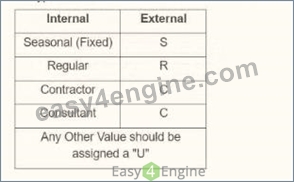
The vendor has also requested that any output file have the following format "CC_Job_Postings_dd-mm-yy_#.xml". Where the dd is the current day at runtime, mm is the current month at runtime, yy is the last two digits of the current year at runtime, and # is the current value of the sequencer at runtime. What configuration step(s) must you complete to meet the vender requirements?
- A. * Enable the Sequence Generator Integration Service * Configure the Sequence Generator * Configure the Worker Sub Type Integration Mapping and include a default value of "U"
- B. * Enable the Sequence Generator Field Attribute * Configure the Sequence Generator * Configure the Worker Sub Type Integration Mapping leaving the default value blank
- C. * Enable the Integration Mapping Integration Service * Configure the Worker Sub Type Integration Mapping and include a default value of "U" * Configure the Sequence Generator
- D. * Enable the Integration Mapping Field Attribute * Configure the Worker Sub Type Integration Mapping leaving the default value blank * Configure the Sequence Generator
Answer: A
Explanation:
This question involves configuring an outbound connector using the Core Connector: Job Postings template in Workday Pro Integrations. We need to meet two specific vendor requirements:
Map worker subtype values according to the provided table (e.g., Seasonal (Fixed) = "S", Regular = "R", Contractor = "C", Consultant = "C", and any other value = "U").
Format the output file name as "CC_Job_Postings_dd-mm-yy_#.xml", where:
"dd" is the current day at runtime,
"mm" is the current month at runtime,
"yy" is the last two digits of the current year at runtime,
"#" is the current value of the sequencer at runtime.
Let's break down the requirements and evaluate each option to determine the correct configuration steps.
Understanding the Requirements
1. Worker Subtype Mapping
The vendor provides a table for worker subtype values:
Internal Seasonal (Fixed) maps to "S"
Internal Regular maps to "R"
Internal Contractor maps to "C"
Internal Consultant maps to "C"
Any other value should be assigned "U"
In Workday, worker subtypes are typically part of the worker data, and for integrations, we use integration mappings to transform these values into the format required by the vendor. The integration mapping allows us to define how internal Workday values (e.g., worker subtypes) map to external values (e.g., "S", "R", "C", "U"). If no specific mapping exists for a value, we need to set a default value of "U" for any unmatched subtypes, as specified.
This mapping is configured in the integration system's "Integration Mapping" or "Field Mapping" settings, depending on the template. For the Core Connector: Job Postings, we typically use the "Integration Mapping" feature to handle data transformations, including setting default values for unmapped data.
2. Output File Name Format
The vendor requires the output file to be named "CC_Job_Postings_dd-mm-yy_#.xml", where:
"CC_Job_Postings" is a static prefix,
"dd-mm-yy" represents the current date at runtime (day, month, last two digits of the year),
"#" is the current value from a sequence generator (sequencer) at runtime.
In Workday, file names for integrations are configured in the "File Utility" or "File Output" settings of the integration. To achieve this format:
The date portion ("dd-mm-yy") can be dynamically generated using Workday's date functions or runtime variables, often configured in the File Utility's "Filename" field with a "Determine Value at Runtime" setting.
The sequence number ("#") requires a sequence generator, which is enabled and configured to provide a unique incrementing number for each file. Workday uses the "Sequence Generator" feature for this purpose, typically accessed via the "Create ID Definition / Sequence Generator" task.
The Core Connector: Job Postings template supports these configurations, allowing us to set filename patterns in the integration's setup.
Evaluating Each Option
Let's analyze each option step by step, ensuring alignment with Workday Pro Integrations best practices and the vendor's requirements.
Option A:
* Enable the Sequence Generator Field Attribute
* Configure the Sequence Generator
* Configure the Worker Sub Type Integration Mapping leaving the default value blank Analysis:
Sequence Generator Configuration: Enabling the "Sequence Generator Field Attribute" and configuring the sequence generator is partially correct for the file name's "#" (sequencer) requirement. However, "Sequence Generator Field Attribute" is not a standard term in Workday; it might refer to enabling a sequence generator in a field mapping, but this is unclear and likely incorrect. Sequence generators are typically enabled as an "Integration Service" or configured in the File Utility, not as a field attribute.
Worker Subtype Mapping: Configuring the worker subtype integration mapping but leaving the default value blank is problematic. The vendor requires any unmapped value to be "U," so leaving it blank would result in missing or null values, failing to meet the requirement.
Date in Filename: This option doesn't mention configuring the date ("dd-mm-yy") in the filename, which is critical for the "CC_Job_Postings_dd-mm-yy_#.xml" format.
Conclusion: This option is incomplete and incorrect because it doesn't address the default "U" for unmapped subtypes and lacks date configuration for the filename.
Option B:
* Enable the Integration Mapping Field Attribute
* Configure the Worker Sub Type Integration Mapping leaving the default value blank
* Configure the Sequence Generator
Analysis:
Sequence Generator Configuration: Configuring the sequence generator addresses the "#" (sequencer) in the filename, which is correct for the file name requirement.
Worker Subtype Mapping: Similar to Option A, leaving the default value blank for the worker subtype mapping fails to meet the vendor's requirement for "U" as the default for unmapped values. This would result in errors or null outputs, which is unacceptable.
Date in Filename: Like Option A, there's no mention of configuring the date ("dd-mm-yy") in the filename, making this incomplete for the full file name format.
Integration Mapping Field Attribute: This term is ambiguous. Workday uses "Integration Mapping" or "Field Mapping" for data transformations, but "Field Attribute" isn't standard for enabling mappings. This suggests a misunderstanding of Workday's configuration.
Conclusion: This option is incomplete and incorrect due to the missing default "U" for worker subtypes and lack of date configuration for the filename.
Option C:
* Enable the Integration Mapping Integration Service
* Configure the Worker Sub Type Integration Mapping and include a default value of "U"
* Configure the Sequence Generator
Analysis:
Sequence Generator Configuration: Configuring the sequence generator is correct for the "#" (sequencer) in the filename, addressing part of the file name requirement.
Worker Subtype Mapping: Including a default value of "U" for the worker subtype mapping aligns perfectly with the vendor's requirement for any unmapped value to be "U." This is a strong point.
Date in Filename: This option doesn't mention configuring the date ("dd-mm-yy") in the filename, which is essential for the "CC_Job_Postings_dd-mm-yy_#.xml" format. Without this, the file name requirement isn't fully met.
Integration Mapping Integration Service: Enabling the "Integration Mapping Integration Service" is vague. Workday doesn't use this exact term; instead, integration mappings are part of the integration setup, not a separate service. This phrasing suggests confusion or misalignment with Workday terminology.
Conclusion: This option is partially correct (worker subtype mapping) but incomplete due to the missing date configuration for the filename and unclear terminology.
Option D:
* Enable the Sequence Generator Integration Service
* Configure the Sequence Generator
* Configure the Worker Sub Type Integration Mapping and include a default value of "U" Analysis:
Sequence Generator Configuration: Enabling the "Sequence Generator Integration Service" and configuring the sequence generator addresses the "#" (sequencer) in the filename. While "Sequence Generator Integration Service" isn't a standard term, it likely refers to enabling and configuring the sequence generator functionality, which is correct. In Workday, this is done via the "Create ID Definition / Sequence Generator" task and linked in the File Utility.
Worker Subtype Mapping: Configuring the worker subtype integration mapping with a default value of "U" meets the vendor's requirement for any unmapped value, ensuring "S," "R," "C," or "U" is output as specified in the table. This is accurate and aligns with Workday's integration mapping capabilities.
Date in Filename: Although not explicitly mentioned in the steps, Workday's Core Connector: Job Postings template and File Utility allow configuring the filename pattern, including dynamic date values ("dd-mm-yy"). The filename "CC_Job_Postings_dd-mm-yy_#.xml" can be set in the File Utility's "Filename" field with "Determine Value at Runtime," using date functions and the sequence generator. This is a standard practice and implied in the configuration, making this option complete.
Conclusion: This option fully addresses both requirements: worker subtype mapping with "U" as the default and the file name format using the sequence generator and date. The terminology ("Sequence Generator Integration Service") is slightly non-standard but interpretable as enabling/configuring the sequence generator, which is correct in context.
Final Verification
To confirm, let's summarize the steps for Option D and ensure alignment with Workday Pro Integrations:
Enable the Sequence Generator Integration Service: This likely means enabling and configuring the sequence generator via the "Create ID Definition / Sequence Generator" task, then linking it to the File Utility for the "#" in the filename.
Configure the Sequence Generator: Set up the sequence generator to provide incremental numbers, ensuring each file has a unique "#" value.
Configure the Worker Sub Type Integration Mapping with a default value of "U": Use the integration mapping to map Internal Seasonal (Fixed) to "S," Regular to "R," Contractor to "C," Consultant to "C," and set "U" as the default for any other value. This is done in the integration's mapping configuration.
Filename Configuration (Implied): In the File Utility, set the filename to "CC_Job_Postings_dd-mm-yy_#.xml," where "dd-mm-yy" uses Workday's date functions (e.g., %d-%m-%y) and "#" links to the sequence generator.
This matches Workday's documentation and practices for the Core Connector: Job Postings template, ensuring both requirements are met.
Why Not the Other Options?
Options A and B fail because they leave the default worker subtype value blank, not meeting the "U" requirement.
Option C fails due to missing date configuration for the filename and unclear terminology ("Integration Mapping Integration Service").
Option D is the only one that fully addresses both the worker subtype mapping (with "U" default) and implies the filename configuration, even if the date setup isn't explicitly listed (it's standard in Workday).
Supporting Documentation
The reasoning is based on Workday Pro Integrations best practices, including:
Workday Tutorial: Activity Creating Unique Filenames from EIB-Out Integrations - Details on using sequence generators for filenames.
Workday Tutorial: EIB Features - Explains integration mappings and default values.
Get_Sequence_Generators Operation Details - Workday API documentation on sequence generators.
Workday Advanced Studio Tutorial - Covers Core Connector templates and file name configurations.
r/workday Reddit Post: How to Create a New Sequence Generator for Filename for EIB - Community insights on sequence generators.
NEW QUESTION # 39
......
You must want to receive our Workday-Pro-Integrations practice questions at the first time after payment. Don’t worry. As long as you finish your payment, our online workers will handle your orders of the Workday-Pro-Integrations study materials quickly. The whole payment process lasts a few seconds. And if you haven't received our Workday-Pro-Integrations Exam Braindumps in time or there are some trouble in opening or downloading the file, you can contact us right away, and our technicals will help you solve it in the first time.
Valid Test Workday-Pro-Integrations Tips: https://www.easy4engine.com/Workday-Pro-Integrations-test-engine.html
- Workday-Pro-Integrations Vce Format 😐 Workday-Pro-Integrations Test Free 🩲 Free Workday-Pro-Integrations Exam 📨 Immediately open ( www.vce4dumps.com ) and search for ⏩ Workday-Pro-Integrations ⏪ to obtain a free download 🥯Exam Workday-Pro-Integrations Fees
- Workday-Pro-Integrations Latest Exam Questions 🌉 Pass Workday-Pro-Integrations Guide 🌐 Visual Workday-Pro-Integrations Cert Exam 🚠 Open website ▛ www.pdfvce.com ▟ and search for ( Workday-Pro-Integrations ) for free download 🅿Workday-Pro-Integrations Latest Exam Questions
- Updated Workday-Pro-Integrations Latest Exam Book - Passing Workday-Pro-Integrations Exam is No More a Challenging Task 🕓 Search for 「 Workday-Pro-Integrations 」 and download it for free on “ www.prepawaypdf.com ” website 😩Workday-Pro-Integrations Valid Test Practice
- Visual Workday-Pro-Integrations Cert Exam 🤼 Workday-Pro-Integrations Valid Test Practice 🦞 Workday-Pro-Integrations Interactive Practice Exam 🆖 Download ☀ Workday-Pro-Integrations ️☀️ for free by simply entering ⏩ www.pdfvce.com ⏪ website 🎹Reliable Workday-Pro-Integrations Study Notes
- Workday-Pro-Integrations Test Free 🙀 Workday-Pro-Integrations Authorized Test Dumps 🥽 Workday-Pro-Integrations Passguide 🎫 Search for ➽ Workday-Pro-Integrations 🢪 on 【 www.validtorrent.com 】 immediately to obtain a free download 🥾Visual Workday-Pro-Integrations Cert Exam
- Workday-Pro-Integrations Get Certified Get Ahead Workday-Pro-Integrations 🕧 Copy URL ☀ www.pdfvce.com ️☀️ open and search for 《 Workday-Pro-Integrations 》 to download for free 👋100% Workday-Pro-Integrations Accuracy
- Latest Workday-Pro-Integrations Braindumps Sheet 📴 100% Workday-Pro-Integrations Accuracy 🔙 Free Workday-Pro-Integrations Exam 🎍 Simply search for ⇛ Workday-Pro-Integrations ⇚ for free download on ▶ www.pdfdumps.com ◀ 🤝Workday-Pro-Integrations Vce Format
- Workday-Pro-Integrations Training Materials 😷 Latest Workday-Pro-Integrations Braindumps Sheet 💁 Pass Workday-Pro-Integrations Guide 🛤 Easily obtain ☀ Workday-Pro-Integrations ️☀️ for free download through ☀ www.pdfvce.com ️☀️ 💖Workday-Pro-Integrations Reliable Exam Labs
- High-quality Workday-Pro-Integrations Latest Exam Book - Perfect Valid Test Workday-Pro-Integrations Tips - Free PDF Exam Workday-Pro-Integrations Outline ⏪ Open website ▛ www.vce4dumps.com ▟ and search for ( Workday-Pro-Integrations ) for free download ♣Workday-Pro-Integrations Training Materials
- Workday Workday-Pro-Integrations PDF Questions – Ideal Material for Quick Preparation 🔩 Download [ Workday-Pro-Integrations ] for free by simply entering ➤ www.pdfvce.com ⮘ website 🧴Workday-Pro-Integrations Reliable Exam Labs
- High-quality Workday-Pro-Integrations Latest Exam Book - Perfect Valid Test Workday-Pro-Integrations Tips - Free PDF Exam Workday-Pro-Integrations Outline 😵 ▛ www.prepawaypdf.com ▟ is best website to obtain “ Workday-Pro-Integrations ” for free download 🎯100% Workday-Pro-Integrations Accuracy
- www.goodreads.com, shortcourses.russellcollege.edu.au, libict.org, freemoon.org, www.stes.tyc.edu.tw, www.stes.tyc.edu.tw, www.stes.tyc.edu.tw, www.stes.tyc.edu.tw, www.stes.tyc.edu.tw, evivid.org, Disposable vapes
P.S. Free & New Workday-Pro-Integrations dumps are available on Google Drive shared by Easy4Engine: https://drive.google.com/open?id=1mdin2xZHo9R8YFL1Hp60A-7KaOngpX1L